跳至主要内容

Interpretation of compressors, condensers, evaporators, and microcomputer control systems of screw chillers - www.oumalchiller.com

 There are many parts of the screw chiller, among which there are several major components, namely the compressor, condenser, evaporator and microcomputer control system of the screw chiller. The operation panel and computer control system of the screw chiller are very important. Therefore, the four parts of compressor, condenser, evaporator and microcomputer control system are the core parts of screw chiller. Let us discuss these four components in detail.
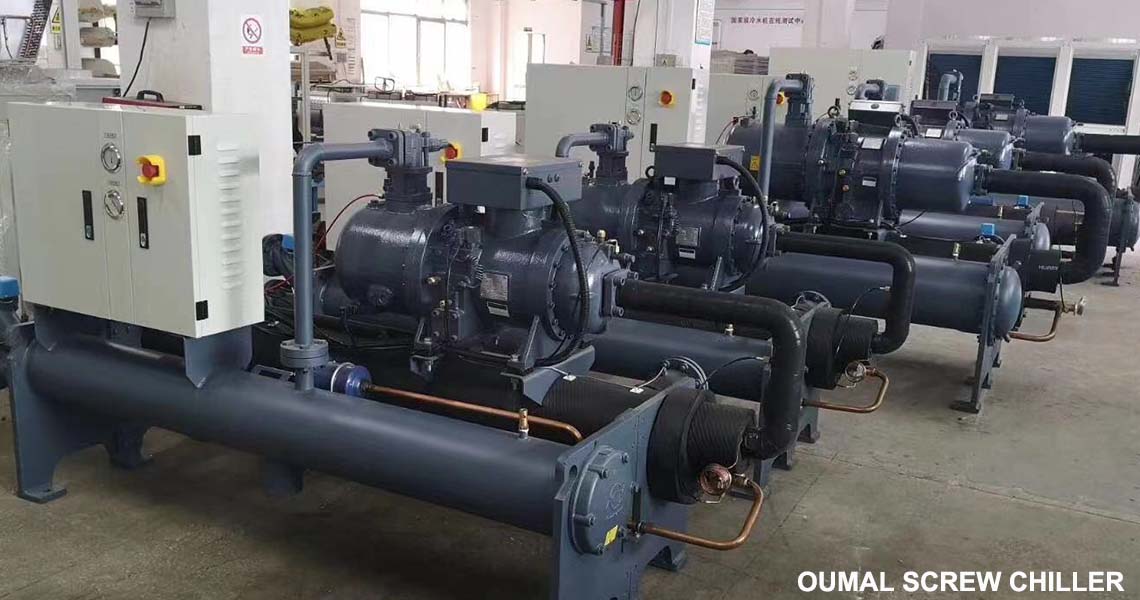

water cooled screw chillers


1. Compressor

As the name suggests, the screw chiller uses a semi-hermetic screw compressor as the compressor of the chiller. There are several major brands of screw compressors we use, such as Hanbell compressors from Taiwan, Bitzer compressors from Germany, or Fusheng compressors from Taiwan. These compressors have reliable quality, low failure rate and high energy efficiency ratio. In contrast to screw chillers, there are scroll chillers and piston chillers. The main brands are Copeland, Danfoss, Bitzer, etc. We won't talk about them here.


2. Condenser

There are two types of condensers for screw chillers. The condenser of the air-cooled screw chiller is a fin type with an additional fan for heat dissipation, while the condenser of the water-cooled screw chiller is a shell and tube type. Therefore, the water-cooled screw chiller The chiller requires an external cooling tower to dissipate heat. Of course, whether it is a water-cooled screw chiller or an air-cooled screw chiller, the condenser must be sufficient to ensure the cooling effect of the chiller and reduce high-voltage failures.


3. Evaporator

Evaporator mainly depends on whether its energy loss is more or less, the less cooling loss is better, and the cooling effect is better. It also depends on whether the structure is compact and the performance is stable. We use shell and tube evaporators for the evaporators of screw chillers.


4. PLC control system

The configured screw chiller, its automatic control system is very high-end, menu-type buttons, and remote monitoring and control, which is very convenient. Such screw chillers can also make you more worry-free to use, even if Operators who don't know anything can use it normally with a little training, which is very user-friendly. Omar screw chiller adopts Siemens PLC control system, or PUNP LCD Touch Screen Control Panel. Omron is optional for client.


To learn more about OUMAL Screw Chiller, please contact us to get the detail information.


评论

此博客中的热门博文

Avoid Downtime, Cut Costs: Smart Maintenance for Smarter Chillers

  Screw water-cooled chillers   typically operate around 3,000 hours per year, depending on China's climate and geographical conditions. Regular and scientific maintenance is crucial to ensure long-term, reliable operation, extend the lifespan, and reduce operating costs. Maintenance and Upkeep Preventive maintenance during operation and inspection involves creating annual and monthly maintenance plans based on actual operating conditions. Shutdown Procedures In winter, clean and dry the unit. Open the drain valve to empty the  shell-and-tube heat exchanger  to avoid freezing. The shutdown sequence is: chiller off - cooling tower fan off - cooling water pump off - chilled water pump off. Special attention to anti-freezing: 1. Drain the evaporator and condenser if the unit is outdoors below 0°C during standby. 2. Interlock the water flow switch with the unit to prevent freezing when the chilled water flow switch malfunctions. 3. Ensure water in the evaporator is flowi...

What Makes High-Temperature Heat Pump Units Essential for Modern Energy Use

  High-temperature heat pump units   have become essential to modern energy utilization technologies, finding widespread applications across various industries such as industrial, agricultural, and commercial sectors. These units' unique performance and advantages are key in driving energy transitions and achieving energy conservation and emission reductions. This blog will explore the working principles, application areas, technical features, and future trends of high-temperature heat pump units. How Do High-Temperature Heat Pump Units Work? High-temperature heat pump units operate based on the principle of the reverse Carnot cycle. They use a small amount of electrical or thermal energy to absorb heat from a low-temperature source and transfer it to a high-temperature source. The process involves four key stages: evaporation, compression, condensation, and expansion. During evaporation, the refrigerant absorbs heat from the low-temperature source and turns into a low-pressur...

What Are the Key Requirements for Flooded-Type Heat Exchangers in Air Suspension Chillers

  Air suspension chillers   are crucial in many industrial and commercial applications, and the flooded-type heat exchanger is one of the most important components of these systems. Understanding the requirements of the heat exchanger is essential to ensuring the air suspension units operate efficiently and remain stable. A flooded-type heat exchanger works by transferring heat between two fluids with different temperatures. In air suspension chillers, it helps regulate temperature, optimize energy use, and improve overall performance. For instance, it can transfer heat from high-temperature gases to low-temperature liquids, or vice versa. 1. Material Requirements 1.1 Corrosion Resistance In many industrial environments, fluids can be corrosive. For example, they may come into contact with acidic or alkaline substances. To withstand these conditions, the heat exchanger’s tubes and casing need to be made from corrosion-resistant materials, such as stainless steel. Stainless ste...