跳至主要内容

How to choose a chiller for the bottle blowing machine | Oumalchiller.com

 What is Blow Molding Machine?

Blow molding machine is a kind of equipment that makes plastic particles into hollow containers through a blow molding process. At present, the more common models include: a hollow extrusion blow molding machine that uses PP and PE for one-time molding, and uses PET, PC or PP for two moldings. The injection-stretch-blowing blow molding machine and the newly developed multi-layer hollow extrusion blow and stretch blow molding. At present, most of the blow molding machines are also two-step blow molding machines, that is, the plastic needs to be made into preforms and then blown. Nowadays, environmentally friendly plastics made of PET are commonly used.


Production process of Blow molding machine

The working process of the bottle blowing machine is generally to place the preform in the preform container, automatically enter the preform positioning device through the conveying device, and then load the preform mouth upwards onto the preform holder, and then send it to the drying tunnel for heating After that, the preform is sent to the blowing platform, and then the mold is locked, followed by low-pressure blowing and high-pressure blowing. After cooling and forming, the high-pressure gas in the bottle is discharged, and finally the mold is opened. The finished bottle is taken from the blowing platform by the automatic demoulding system Come down. In the cooling molding process, the chilled water provided by the chiller is used to cool the bottle wall and prevent the mold from overheating and damage.


What is a blow molding chiller ?

Blow molding chiller is the cooling system which provide cooling water for the blow molding machine. Because the bottle blowing machine generates a lot of heat during the production process, and the ambient temperature is getting higher and higher, tap water or cooling towers can no longer cool the bottle blowing machine, resulting in a decline in product refrigeration. Therefore, the bottle blowing machine chiller Used, it can effectively improve the surface finish of plastic products, reduce the surface marks and internal stress of plastic products, make the products do not shrink or deform, reduce defective products, is suitable for demoulding of plastic products, accelerate product shaping, and shorten the injection molding cycle. Greatly improve the production efficiency of the bottle blowing machine.
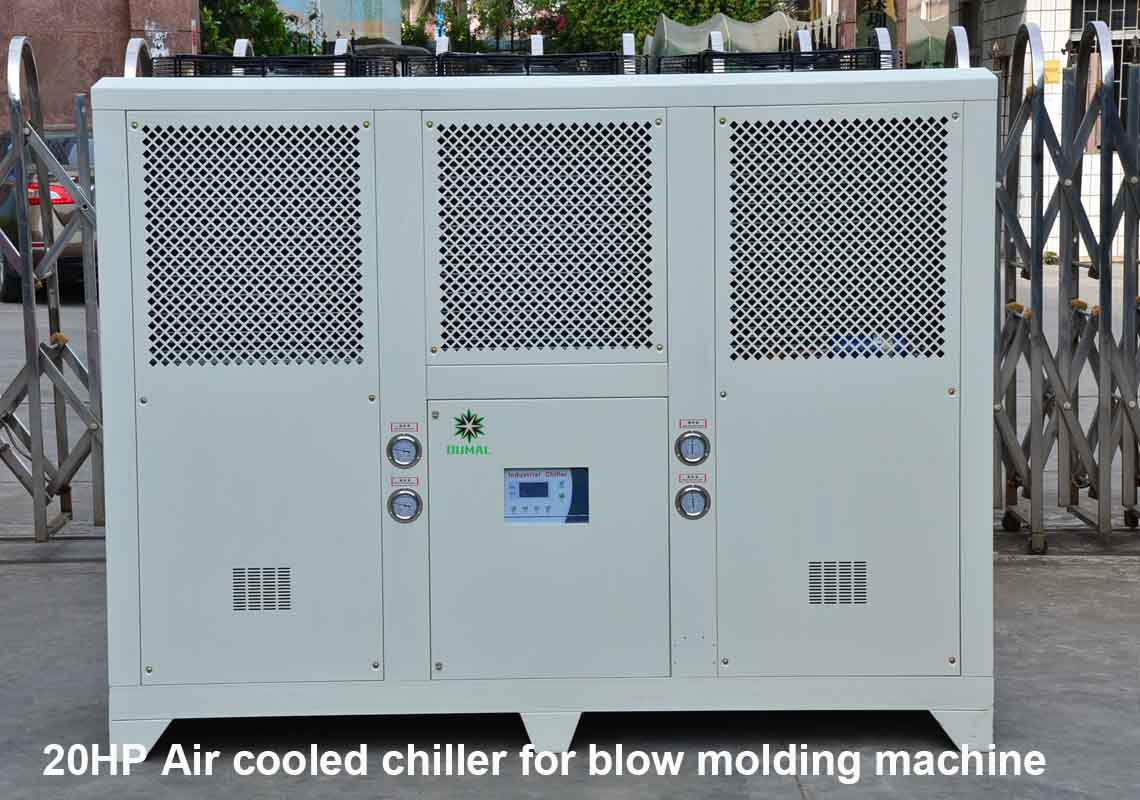

air cooled chiller for blowing machine


How to choose a suitable chiller for the bottle blowing machine.

First determine the control temperature and cooling capacity required by yourself, such as how much water you need per minute to finalize. Generally, the water chiller is selected according to the requirements for cooling water provided by the blowing machine manufacturer. Generally, the temperature of the outlet water is 10℃, and the cooling water flow requirements of different models. Some manufacturers will directly mark the horsepower of the chiller in the parameters.


If you are looking for the industrial chiller for your bottle blow machine, You are welcomed to contact us to get the blow molding chiller price.


评论

此博客中的热门博文

Avoid Downtime, Cut Costs: Smart Maintenance for Smarter Chillers

  Screw water-cooled chillers   typically operate around 3,000 hours per year, depending on China's climate and geographical conditions. Regular and scientific maintenance is crucial to ensure long-term, reliable operation, extend the lifespan, and reduce operating costs. Maintenance and Upkeep Preventive maintenance during operation and inspection involves creating annual and monthly maintenance plans based on actual operating conditions. Shutdown Procedures In winter, clean and dry the unit. Open the drain valve to empty the  shell-and-tube heat exchanger  to avoid freezing. The shutdown sequence is: chiller off - cooling tower fan off - cooling water pump off - chilled water pump off. Special attention to anti-freezing: 1. Drain the evaporator and condenser if the unit is outdoors below 0°C during standby. 2. Interlock the water flow switch with the unit to prevent freezing when the chilled water flow switch malfunctions. 3. Ensure water in the evaporator is flowi...

What are the differences between air-cooled chillers and water-cooled chillers | Oumalchiller.com

  We all know that according to different heat dissipation methods, chillers can be divided into air-cooled chillers and water-cooled chillers. What is the difference between air-cooled chillers and water-cooled chillers? ​ 1. The  air-cooled chiller  uses copper tubes and aluminum fins to dissipate heat from the condenser. A fan is required to blow the outdoor air through the heat exchange fins and take away the heat of the condenser, so the air-cooled chiller does not need to be connected to the cooling tower. But compared with water-cooled chillers, under the same power, air-cooled chillers have larger equipment size and higher noise. The condenser of water-cooled chillers exchanges heat with the cooling water from the cooling tower through the heat exchanger. The excess waste heat will be transported to the cooling tower through the cooling water loop and released into the atmosphere, or enter the water-water heat exchanger or soil heat exchange coil for storage. Ther...

What is difference between centrifugal chiller and screw chillers?

 Water Chillers are generally divided into the following categories: screw chillers, centrifugal chillers, water ring heat pump units, plate and tube evaporative condensing screw chillers, thermal storage air conditioners, etc. Screw chiller and centrifugal chiller are equipment that we often encounter. Below,  Oumal Refrigeration  will take you to understand the difference between centrifugal chiller and screw chiller? What is a  screw chiller ? The compressor adopts a screw type, hence the name screw chiller. The refrigerant coming out of the evaporator of the unit is a gas; after adiabatic compression by the compressor, it becomes a high-temperature and high-pressure state. The compressed gas refrigerant is isobarically cooled and condensed in the condenser. After condensation, it changes into liquid refrigerant, and then expands to low pressure through the throttle valve and becomes a gas-liquid mixture. The liquid refrigerant under low temperature and low pressu...